

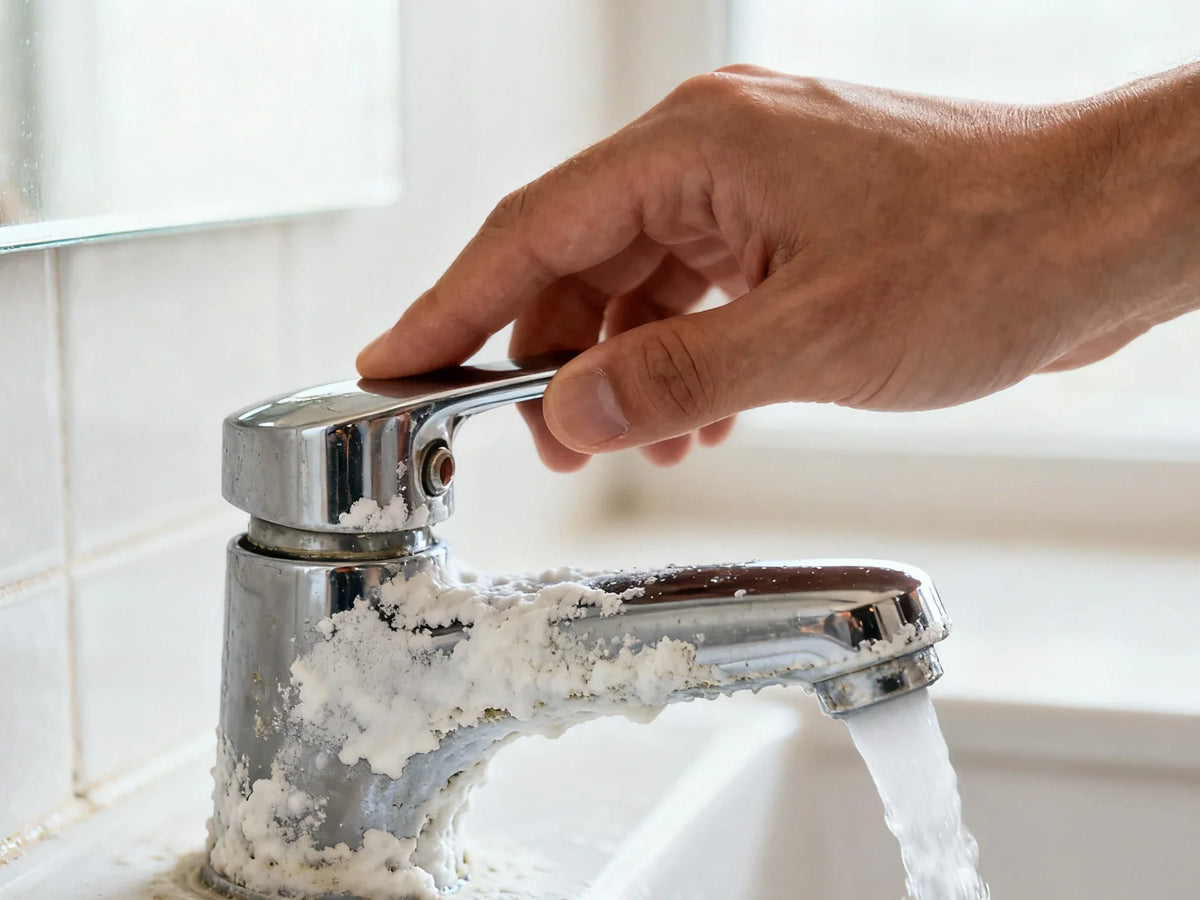
Limescale is one of those household issues that tends to become noticeable gradually. A bathroom fitting may develop a white ring, a shower screen can become marked with water spots, and a kettle may need descaling more frequently. None of these problems is necessarily serious on its own, but together they can create an ongoing maintenance job.
For homeowners in hard-water areas, these deposits are linked to naturally occurring minerals in the water supply. Calcium and magnesium are responsible for water hardness, and when water is heated or evaporates from a surface, mineral deposits can remain behind.
There are several ways to approach the problem, from regular cleaning through to dedicated water-treatment equipment. Understanding the available choices can help homeowners decide what makes sense for their property.
Where Does Limescale Build Up?
The bathroom is usually one of the easiest places to spot the effects of hard water.
Taps, showerheads and other fittings can develop deposits where water repeatedly comes into contact with the surface. Shower screens and tiles can also become marked when droplets are left to dry naturally.
The kitchen provides another familiar example. Kettles repeatedly heat water, making them particularly prone to visible deposits. Other appliances that use or heat water can also require periodic cleaning and descaling.
How quickly these deposits develop depends on several factors, including the hardness of the local supply and the way water is used within the home.
This is why homeowners should avoid making assumptions based solely on where they live. Water hardness can vary considerably between areas, and checking information from the local water supplier provides a more useful starting point.
It is also important to distinguish limescale from other plumbing problems. A leak, blocked pipe or sudden change in water pressure may require a plumber rather than water-conditioning equipment.
Managing Limescale Through Everyday Maintenance
For some households, the simplest solution is regular cleaning.
Wiping taps, shower fittings and other wet surfaces can reduce the amount of water left to evaporate. Showerheads can be cleaned periodically, while kettles and suitable appliances can be descaled according to their manufacturers’ instructions.
This approach has the advantage of being straightforward and inexpensive. It may be all that is needed where deposits are relatively light or restricted to a few areas.
The disadvantage is that the maintenance never really disappears. In a hard-water area, deposits can return after cleaning, meaning homeowners need to repeat the process.
For people who find regular descaling increasingly inconvenient, investigating a dedicated Aquabion water conditioner is one possible route when considering ways to manage the effects of hard water.
Understanding Water Conditioning
Water conditioning is different from simply filtering water, and it should also be distinguished from conventional water softening.
Traditional ion-exchange water softeners are designed to reduce calcium and magnesium in treated water. They typically involve a resin-based process and may require salt and regeneration as part of their operation.
Conditioning systems can use different technologies. Rather than necessarily removing the minerals responsible for hardness, some are designed to influence how scale forms or behaves.
This distinction is important when researching products. Homeowners should consider what a system is specifically designed to do rather than assuming that every water-treatment product provides the same result.
The choice can also depend on what the homeowner wants to achieve. Someone primarily concerned with bathroom cleaning may have different priorities from a household looking at limescale throughout its plumbing system.
What Should You Check Before Choosing a System?
A little preparation can make the selection process much easier.
Start by establishing the hardness of the local water supply. This gives homeowners a better understanding of the conditions the system will be dealing with.
Next, look at the plumbing layout. If the intention is to treat water entering the whole property, the location of the incoming mains supply becomes particularly important. There needs to be suitable access and enough space for the equipment.
Older homes can sometimes have complicated pipework arrangements, so an installer may need to assess the proposed location before installation.
Household water use is another consideration. The needs of a small flat will not necessarily be the same as those of a larger family home with multiple bathrooms and frequent hot-water use.
Homeowners should also review the manufacturer’s installation guidance and check whether professional installation is recommended.
Installation Is Part of the Purchase
It can be tempting to concentrate on the price of a water conditioner and think about installation afterwards. In practice, the two should be considered together.
The cost and complexity of installation can depend on where the equipment needs to be fitted and how accessible the existing pipework is.
A suitably qualified plumber can assess the installation point and identify whether any alterations are likely to be needed. This can help prevent unexpected complications once the work has started.
The physical size of the equipment can matter too. A system may need to be installed in a utility area, cupboard or near the point where the mains supply enters the property. Ensuring that there is enough space and reasonable access can make future maintenance easier.
Homeowners should also check the relevant installation and water-fittings requirements rather than assuming that any product can be connected to the domestic supply without consideration.
Maintenance and Cost Over Time
The purchase price is only one part of the cost of water-treatment equipment.
Some systems require consumables, replacement components or regular servicing. Others are designed to minimise ongoing maintenance. These differences can affect the total cost over the life of the equipment.
A homeowner should therefore ask what routine attention is required before deciding which system to purchase.
Maintenance can also influence convenience. A system that requires frequent intervention may be less appealing to someone looking for a low-maintenance approach, while another household may be comfortable carrying out regular checks.
The same principle applies to cost. A lower initial price does not necessarily mean lower overall expenditure if additional servicing or replacement components are required.
Comparing the complete ownership requirements provides a more useful picture than looking at the purchase price alone.
Exploring an Alternative Conditioning Option
Homeowners comparing different approaches may also want to consider the Inta ActivFlo Water Conditioner.
According to the product information, ActivFlo is an inline system designed for installation on the incoming mains supply. It uses a catalytic alloy coil as part of its approach to limescale protection and is described as operating without salt, chemicals or electricity.
For homeowners specifically investigating a salt-free conditioning approach, these characteristics may be relevant when comparing available systems. However, the product should still be assessed according to the individual property’s plumbing, water usage and installation conditions.
The manufacturer’s current product information should be checked before purchase so that homeowners understand the relevant installation requirements and available configurations.
As with any water-treatment equipment, the fact that a system is designed for domestic use does not mean it will automatically be suitable for every home. The installation environment and household requirements remain important.
Comparing Different Approaches
There are several factors homeowners can use when comparing water-conditioning options.
Consider the Household
Think about the number of occupants, number of bathrooms and typical water usage. These details can help establish the scale of the requirement.
Look at Installation
Identify where the incoming mains supply enters the property and determine whether there is suitable access and space for the equipment.
Understand Maintenance
Check whether the system requires servicing, replacement parts, consumables or other routine attention.
Calculate the Full Cost
Consider the equipment, installation and ongoing expenses together rather than focusing exclusively on the initial purchase price.
Understand the Technology
Find out whether the system softens water, conditions it or uses another treatment method. This can prevent unrealistic expectations about what the equipment is intended to achieve.
Taking a Sensible Approach to Limescale
There is no single way for every UK homeowner to manage hard-water deposits. Some households may find that regular cleaning and descaling are sufficient, while others may decide that dedicated water-conditioning equipment is worth investigating.
The most useful starting point is to understand the local water hardness and identify where limescale is causing the greatest inconvenience. From there, homeowners can compare different technologies according to installation, maintenance, household requirements and overall cost.
Products such as Aquabion and ActivFlo represent individual approaches within the wider water-conditioning market, but homeowners should assess each system on its own characteristics rather than assuming that every conditioner works in the same way.
With careful planning and realistic expectations, water conditioning can be considered as part of a broader strategy for managing the practical effects of hard water and keeping household plumbing and fittings easier to maintain.